


Turn CO₂ into lasting industrial value
An alternative pathway to conventional CCS: transform captured CO₂ into hydrogen, solid carbon and new functional materials.
Graforce’s Circular Carbon Platform combines CO₂ capture, e-methanation and methane plasmalysis in an integrated process. Instead of transporting captured CO₂ for permanent geological storage, the carbon is converted into solid, usable material.
The result is a circular carbon pathway that combines industrial decarbonisation with the production of low-carbon hydrogen and valuable solid carbon.
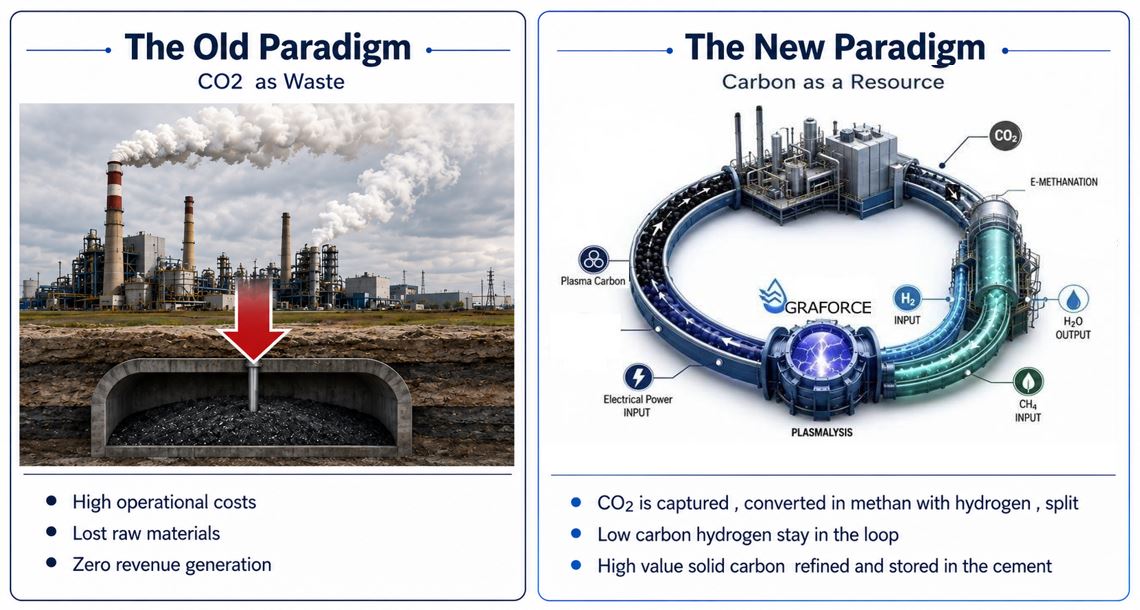
From CO₂ emissions to solid carbon
The platform integrates established CO₂ capture and methanation technologies with Graforce’s plasma technology.
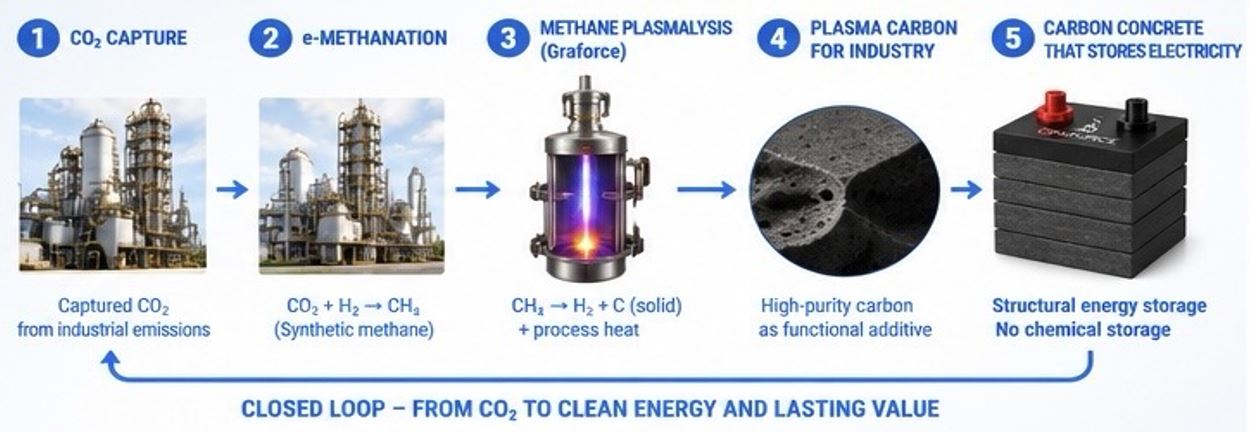
1. CO₂ Capture
CO₂ is captured directly from industrial emissions, including cement, lime, steel and other hard-to-abate processes.
2. e-Methanation
Captured CO₂ reacts with hydrogen to produce synthetic methane.
3. Methane Plasmalysis
Graforce’s plasma technology converts the methane into hydrogen and solid carbon.
4. Hydrogen Recycling
The hydrogen is returned to the methanation process, creating an integrated carbon conversion loop.
5. Carbon Utilisation
The resulting solid carbon becomes a valuable industrial raw material instead of a CO₂ stream requiring transport and geological storage.
From CO₂ liability to a valuable carbon resource. You can find further information in our flyer. Flyer_GRAFORCE_ CO2_Loop_Plattform herunterladen
One platform – multiple industrial applications
The solid carbon produced by the Circular Carbon Platform can replace fossil carbon materials or enable entirely new products.
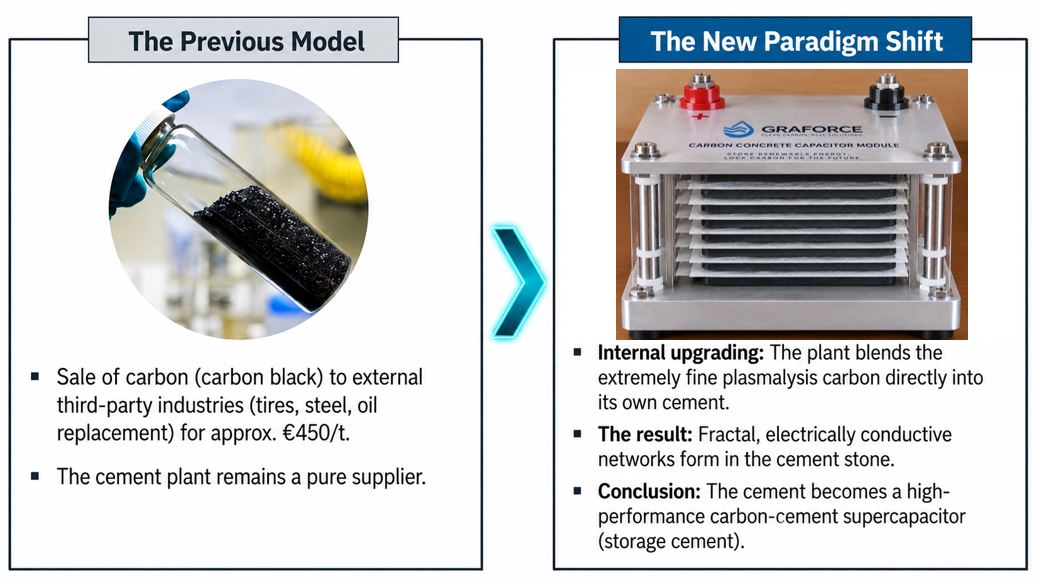
For the steel and lime industries, it creates a pathway for converting unavoidable process emissions into a solid carbon resource.
For the cement industry, the opportunity goes further: carbon can become a functional component of concrete itself.
Carbon Concrete Capacitor
From construction material to structural energy storage
By integrating conductive carbon into cement-based materials, concrete can gain additional electrical functionality.
In a Carbon Concrete Capacitor, conductive carbon electrodes and a porous separator form an electrochemical double-layer energy storage system. Unlike conventional batteries, the concept does not rely on chemical energy storage in critical battery materials.
The objective is to combine two functions in the same material:
structural performance + electrical energy storage.
This opens the possibility of using buildings and infrastructure not only as structures, but also as distributed energy-storage assets.
More than energy storage
Conductive carbon concrete can potentially provide additional functionality beyond energy storage. Its electrical conductivity can enable resistive heating directly within concrete elements, creating potential applications in heated building components and infrastructure, including ice prevention.
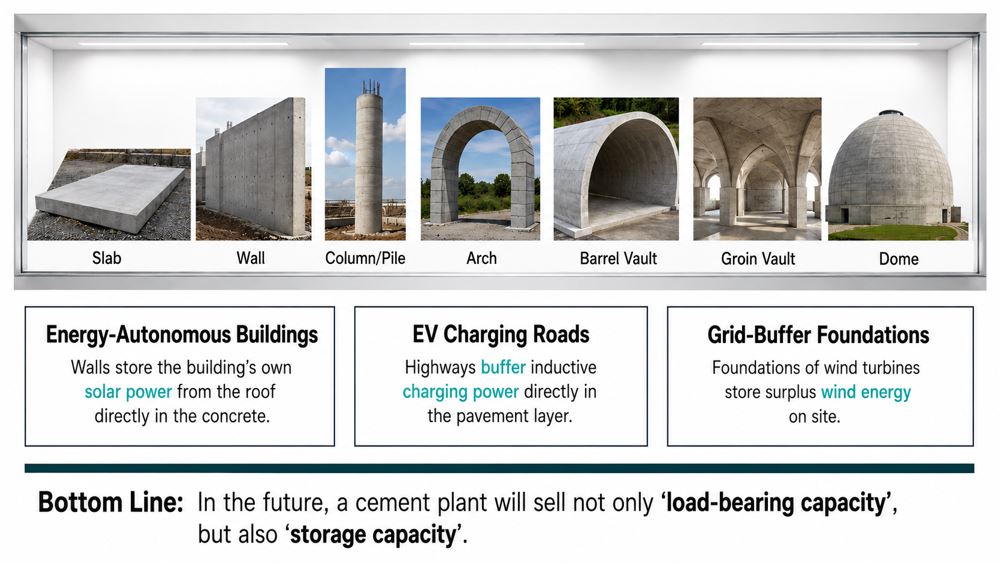
This means that carbon derived from industrial CO₂ could ultimately become part of a material that carries loads, conducts electricity, stores energy and generates heat.
A new business case for the cement industry
Today, decarbonisation is primarily a cost for cement producers. The Circular Carbon Platform introduces a different perspective.
Instead of treating captured CO₂ exclusively as a waste stream that must be transported and stored, its carbon content becomes the basis for higher-value products.
Energy-storage and electrically functional cement could therefore create a new premium product category for the cement industry — moving beyond the traditional commodity business toward multifunctional construction materials.
CO₂ becomes carbon. Carbon becomes functionality. Functionality creates value.
Designed for hard-to-abate industries
The Circular Carbon Platform is particularly relevant for industries with unavoidable or difficult-to-eliminate CO₂ emissions:
Cement · Lime · Steel · Chemicals · Refineries
It provides an alternative carbon-management pathway for industrial sites where conventional CCS would otherwise require CO₂ conditioning, transport infrastructure and access to permanent geological storage.
Start Your Carbon Loop Project
Are you looking for an alternative to conventional CCS or exploring how your industrial CO₂ emissions can be converted into valuable products?
Contact us to evaluate your specific application. Together, we can assess your CO₂ stream, develop an initial mass and energy balance, calculate the economics of a Carbon Loop solution and identify suitable carbon applications.
Whether you are in the cement, lime, steel or process industry, we can support you from the first calculation to a concrete industrial application project.
Let’s calculate your case.
Contact Graforce to start your feasibility assessment and application project.